
5G Is Now the Baseline
5G is no longer the future — it’s the floor. Carriers like AT&T, Verizon, Nokia, and Ericsson have blanketed most markets, and standalone and private 5G networks now run factory floors, campuses, and office buildings. With 5G Advanced rolling out and 6G research already underway, faster broadband and rock-solid mobile connectivity have pushed many companies to go fully wireless — provided security is handled properly.
5G’s applications have made cities, vehicles, and buildings smarter. Manufacturing facilities lean heavily on IoT and IIoT, and higher device-to-device speeds keep production lines fast, improve quality, and help manufacturers pull ahead of competitors.
This connectivity is the backbone of smart office technology, making workplace communication faster and more reliable than ever — and it is the first layer every smart office is built on.
Related from Valicom: future open networking open ran and what it means for your network.
Applications Are Getting Smarter
Enterprise software now handles much of its own upkeep. Cloud platforms auto-patch, auto-scale, and self-tune, saving admins time and effort, while AI copilots are built into everyday tools. This sharpens the user experience and streamlines complicated workflows. Industry research shows the majority of organizations now use AI in at least one business function, and Gartner’s 2026 digital workplace guidance points to “everyday AI” becoming ambient rather than exceptional.
Machine learning also powers predictive operations. Energy and utility providers use intelligent applications and sensor data to flag tiny changes in throughput, prompting technicians to inspect the right asset before it fails. Drones dispatched to the site help crews identify problems quickly and safely, improving both safety and productivity — a hallmark of mature smart office technology.
Ultrathin, Low-Code Apps
Stripped-down micro-apps are a quiet staple of the smart office, letting users tap into just the functionality they need, making tools easy to use across phones, tablets, and wearables. Expense workflows, for example, once lived inside heavy solutions that demanded serious computing power. Today’s low-code platforms — like Microsoft’s Power Apps and Power Automate — collapse those tasks into a single tap on your phone.
As applications get more capable, extracting full value from them takes a partner that specializes in transforming the digital experience and rethinking how your employees complete their work with smart office technology.
Related from Valicom: bridge talent gap best way so your team keeps pace with the tools.
Smart Office Technology Is Transforming the Workplace Itself
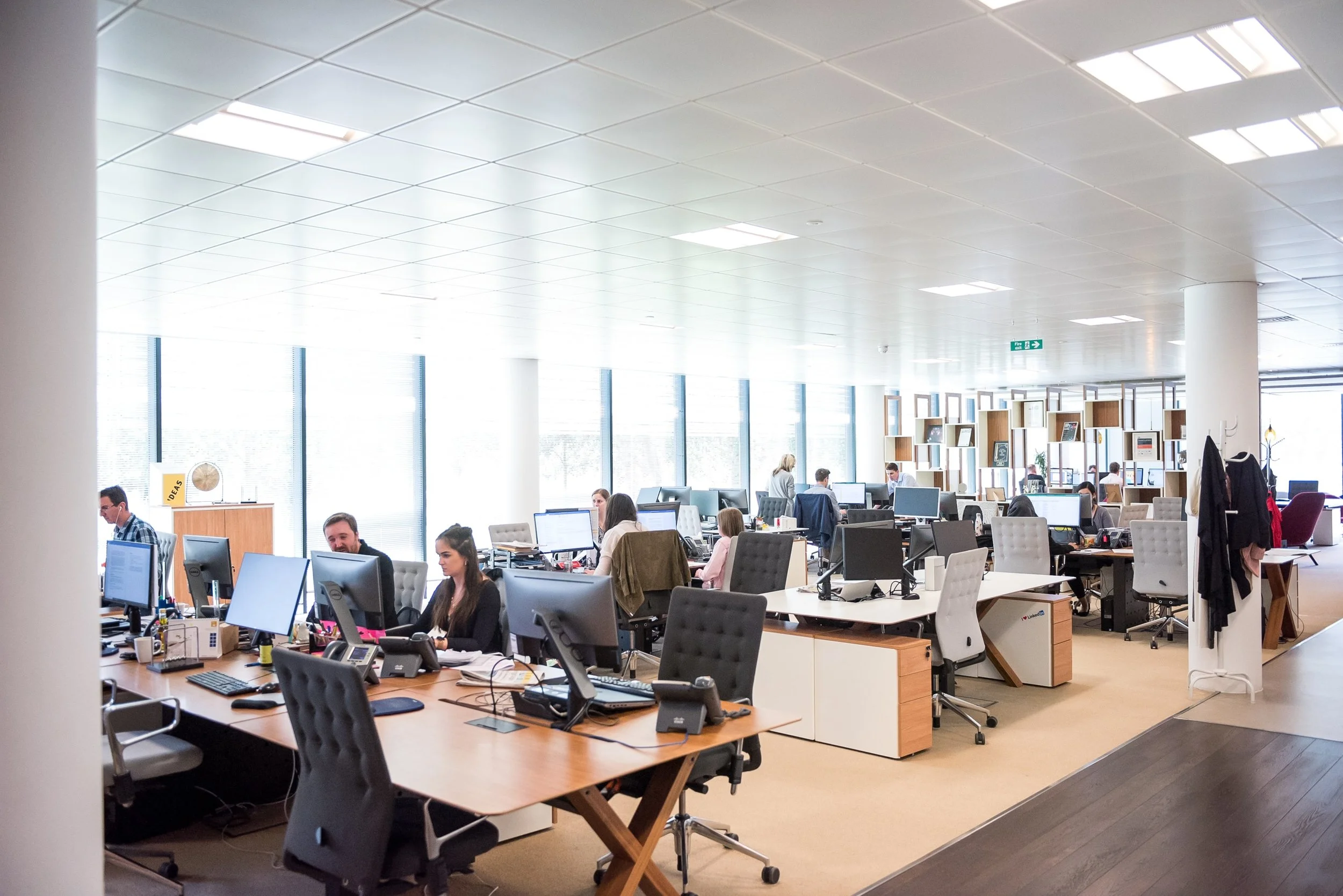
Some forward-thinking leaders are transforming the workspace itself — a powerful way to differentiate a brand. Smart spaces integrate the environment with the work people actually do, designing around their processes to boost productivity. This is smart office technology applied at the architectural scale.
This takes a holistic approach: HR, facilities, finance, IT, and the lines of business have to form one cohesive strategy and culture. Tearing down silos and getting people to interact and know one another leads to more collaborative, dynamic output.
Smart buildings also drive energy savings, using occupancy data and heating and cooling trends to trim waste automatically.
Related from Valicom: benefits cost-cutting industry save money across your facilities and IT.

Improving Space Utilization
Hybrid work has made space utilization a top priority, and it is one of the most visible payoffs of smart office technology. Growing businesses want to use every square foot without sacrificing employee comfort, and one of the toughest nuts to crack is the mostly empty conference room. With room- and desk-booking apps, occupancy sensors, and Wi-Fi analytics, designers can build collaboration hubs that take up far less room than traditional meeting spaces.
By analyzing where and why employees actually meet, many organizations discover that a handful of small “huddle rooms” serve them better than oversized videoconference suites that sit idle.
Data Authenticity Is Key to Business Growth
In the smart office, AI and machine learning increasingly verify workplace data. Unverified data is a danger to any organization, since leaders often base decisions on inaccurate or stale information — and in the age of generative AI, bad inputs produce confidently wrong outputs. A major area of innovation is validating the accuracy of the data fed to company leaders and customers.
Validation used to fall entirely to analysts who prepared or audited system reports; if they didn’t cross-check data points, errors slipped into the final work product. Machine learning now simplifies verification across systems and improves the accuracy of company reporting as a whole.
This matters most in budgeting and forecasting, where a prediction is only as good as the information behind it and its value degrades quickly over time. Machine learning values are compared against manually entered figures from a company’s CRM, land close to those numbers, and often become more accurate than them over time.
Conversational AI: Long Past “Goodbye, Siri?”
A few years ago, voice assistants were a punchline — buggy voice-to-text that forced you to repeat yourself and garbled the results anyway. That era is over. By 2026, conversational AI runs on large language models that interpret complex, nuanced language, hold context across a conversation, and even read emotional tone. Assistants like Microsoft Copilot and other LLM-based agents draft, summarize, and take action across your tools, while purpose-built chipsets and SoCs isolate the human voice even in noisy open-plan offices.
These systems have transformed how we communicate in and out of the office — and how we direct the IoT devices, wearables, and smart office systems around us.
Making the Most of Smart Office Technology in 2026
Smart office technology is no longer a glimpse of the future; it’s the operating environment for modern work. The organizations that pull ahead are the ones that adopt these innovations deliberately and keep a tight handle on what they cost, so every upgrade pays for itself. Start with the pieces that move your productivity needle the most, and build your smart office from there.